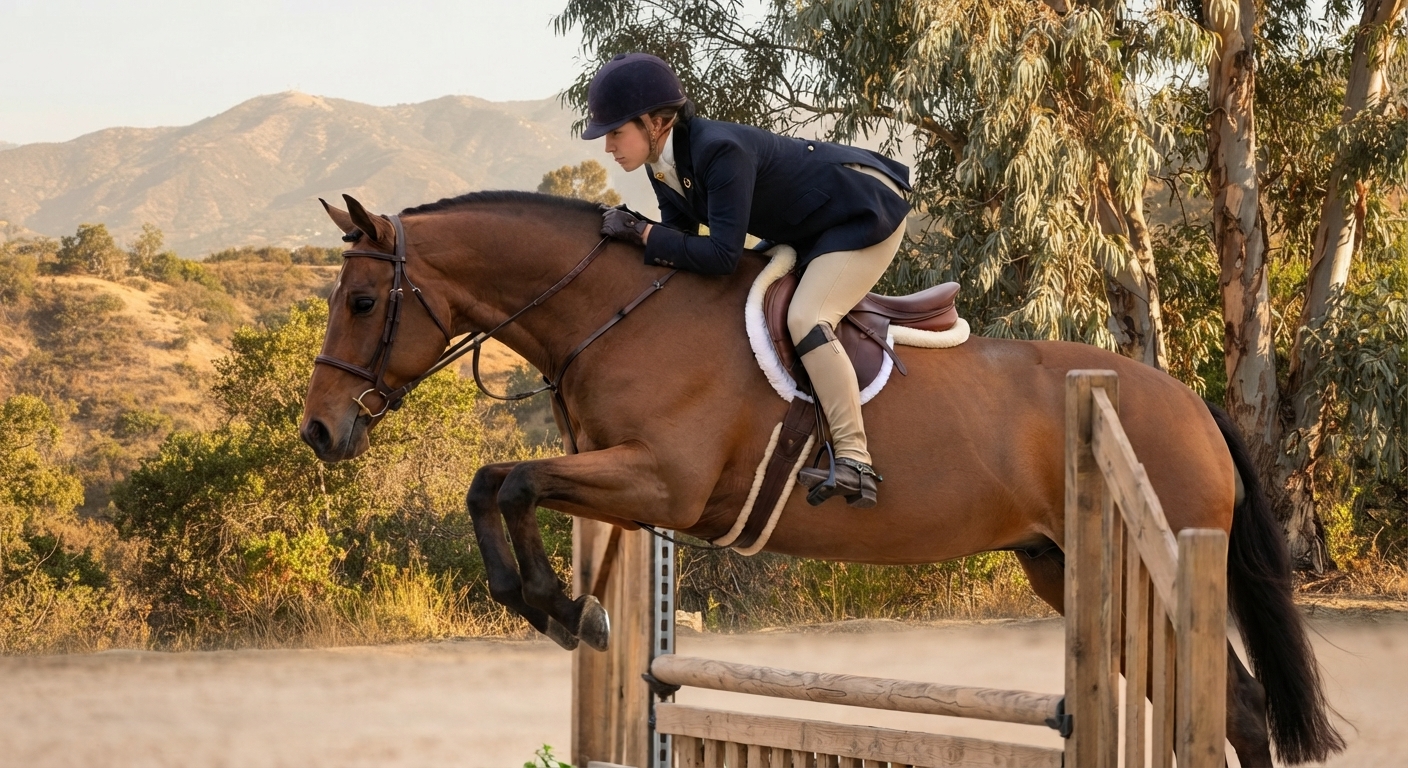
Few American regions have an equestrian identity as deeply connected to sport, landscape, glamour, and civic ambition as Southern California. From the coastal canyons of Pacific Palisades to the foothills beneath the San Gabriel Mountains, Los Angeles has repeatedly used its climate, geography, sporting institutions, and horse culture to create Olympic spectacle.
When the world's leading horse-and-rider combinations arrive for the Olympic Games Los Angeles 2028, they will not merely enter another competition venue. They will return to a region shaped by nearly a century of Olympic equestrian history—beginning with the Depression-era Games of 1932, continuing through Santa Anita Park's pivotal role in 1984, and culminating in the unified Santa Anita program planned for LA28.
The story is not one of a single permanent Olympic horse-sport complex. It is a story of adaptation. In 1932, Los Angeles staged equestrian competition at Riviera Country Club, the Olympic Stadium in Exposition Park, and a cross-country site near Inglewood. In 1984, Santa Anita Park became the heart of the program, while the eventing cross-country phase was held at Fairbanks Ranch in Rancho Santa Fe. In 2028, all Olympic equestrian disciplines are planned for Santa Anita Park, reconnecting the Games with one of Southern California's most important historic equestrian venues.
Table of Contents
- 1932: A Depression-Era Olympic Experiment
- Riviera Country Club: Dressage and Eventing
- The Coliseum and Baron Nishi's Olympic Gold
- 1984: Santa Anita and the Modern Olympic Model
- Santa Anita Park: Olympic Horse Sport at a Racing Landmark
- Fairbanks Ranch and the Eventing Cross-Country Test
- 2028: Returning to Santa Anita Park
- From a Multi-Site Program to a Unified Venue
- A Century of Olympic Horse Sport
- Los Angeles Olympic Equestrian Venues: Then and Now
- Frequently Asked Questions
1932: A Depression-Era Olympic Experiment
Los Angeles hosted the Games of the X Olympiad from July 30 through August 14, 1932, at the height of the Great Depression. Long-distance international travel was expensive, the global economy constrained participation, and Los Angeles had to prove that a West Coast city could stage a world-class sporting event.
The city responded with an ambitious model for hosting. Los Angeles created what is commonly regarded as the first purpose-built modern Olympic Village, a temporary community in Baldwin Hills that included cottages, dining, medical services, recreation, and other support functions for athletes. The innovation had limits by modern standards: the village housed male athletes, while women competitors were accommodated separately at the Chapman Park Hotel. Still, the model helped shape the future of Olympic logistics.
Equestrian competition reflected Los Angeles' distinctive mix of private clubs, large civic venues, and open Southern California terrain. Instead of concentrating horse sport in one purpose-built complex, the organizers distributed events among Riviera Country Club in Pacific Palisades, the Olympic Stadium at the Los Angeles Memorial Coliseum, and land near Inglewood.
Riviera Country Club: Dressage and Eventing
Riviera Country Club was one of the principal equestrian venues of the 1932 Games. Its polo field was transformed for dressage, with a temporary stadium reported to accommodate approximately 6,500 spectators. The setting placed classical European horsemanship within one of the region's most recognizable private sporting landscapes.
The dressage field was small by present-day Olympic standards, with 10 riders representing four nations. Yet the competition carried technical significance: the Olympic dressage test included piaffe and passage for the first time. France's Xavier Lesage won individual gold aboard Taine, while France also won the team dressage gold medal.
Riviera also hosted major portions of the four-day eventing competition. The event was spread across more than one location, however. While Riviera handled much of the program, the cross-country phase took place near Inglewood. The Netherlands' Charles Pahud de Mortanges won individual eventing gold aboard Ferdinand, and the United States captured team gold.
The limited number of completed team results also illustrates the constraints of the era. Only the United States and the Netherlands completed the team eventing requirement, so no bronze medal was awarded.
The Coliseum and Baron Nishi's Olympic Gold
Individual jumping was staged at the Olympic Stadium associated with the Los Angeles Memorial Coliseum in Exposition Park. It was an unusually grand setting for the discipline, replacing the relative intimacy of a traditional showground with an Olympic stadium, vast grandstands, and the pageantry of the central Games venue. Contemporary accounts placed attendance for the individual jumping competition at roughly 100,000 spectators.
The event produced one of the most memorable stories in Olympic equestrian history. Japan's Baron Takeichi Nishi won individual jumping gold aboard Uranus, becoming an international celebrity and an enduring figure in Olympic lore. Nishi remains Japan's only Olympic gold medalist in equestrian sport.
Nishi's victory gained fresh relevance in 2024, when Japan won team eventing bronze at the Paris Olympics. That medal was widely recognized as Japan's first Olympic equestrian medal since Nishi's Los Angeles gold 92 years earlier.
The 1932 team jumping competition also reflects the challenges of the Depression-era Games. Although individual medals were awarded, the team competition was declared void because no nation had three riders complete the course. The small field and incomplete team results offer a more specific measure of the era's travel and participation limitations than a general reference to reduced international attendance.
Even with those limitations, Los Angeles had established itself as a credible international equestrian host. The city demonstrated that its private clubs, civic stadiums, favorable climate, and varied terrain could support competition at Olympic scale.
Riviera's Olympic legacy continues: Riviera Country Club hosted portions of both the equestrian and modern pentathlon programs in 1932. In 2028, the Pacific Palisades club will return to the Olympic stage as the venue for men's and women's golf. That transition—from horse sport and pentathlon to golf—makes Riviera one of the clearest physical links between Los Angeles' 1932 and 2028 Olympic landscapes.
1984: Santa Anita and the Modern Olympic Model
When Los Angeles hosted the Summer Olympics again in 1984, the city did so under dramatically different economic and organizational conditions. Led by Peter Ueberroth and the Los Angeles Olympic Organizing Committee, LA84 became a landmark in Olympic business and event management.
Rather than depending on a vast program of new public construction, organizers relied extensively on existing Southern California facilities, private financing, sponsorships, broadcast revenue, and disciplined operational planning. The Games became a prominent example of how a modern Olympics could use established infrastructure rather than build an entirely new sporting city.
Although the Los Angeles Memorial Coliseum again served as a centerpiece of LA84 for the Opening and Closing Ceremonies and track and field, Olympic equestrian competition was based at Santa Anita Park in Arcadia. Eventing cross-country was staged separately at Fairbanks Ranch in Rancho Santa Fe.
Equestrian sport fit LA84's existing-venue strategy especially well. Rather than building a new Olympic horse-sport complex, organizers selected Santa Anita Park, one of the country's most recognizable Thoroughbred racing venues and a facility already equipped with the scale, stabling, operational experience, and spectator infrastructure required for a global equestrian championship.
Santa Anita Park: Olympic Horse Sport at a Racing Landmark
Opened in 1934, Santa Anita brought decades of horse-industry experience to the 1984 Olympics. Situated beneath the San Gabriel Mountains, the historic track offered substantial stabling, large grandstands, established transport access, experienced equine operations, and a visual setting well suited to international television.
The Santa Anita complex covered roughly 320 acres and offered stabling for more than 2,000 horses. Those logistics matter greatly in Olympic equestrian sport. A successful venue requires much more than a competition arena: it must accommodate secure stabling, horse transportation, veterinary care, feed and bedding, exercise areas, athlete services, event officials, security, and constant operational support.
Santa Anita hosted dressage and jumping competitions, along with the dressage and jumping phases of eventing. Its Art Deco grandstand, expansive racing facility, and mountain backdrop gave the 1984 program a distinctly Southern California identity.
The venue also produced some of the defining performances of the Los Angeles Games. In dressage, West Germany's Reiner Klimke won individual gold aboard Ahlerich and led his country to team gold. Klimke's individual title in Los Angeles became the crowning Olympic moment of an extraordinary dressage career, as Olympics.com records.
Jumping brought one of the most memorable home-nation achievements of LA84. Joe Fargis and Touch of Class won individual gold, while Conrad Homfeld and Abdullah took silver. The United States also won team jumping gold — its first Olympic team title in the discipline, as the FEI's own history of the Games recounts. That same history credits Fargis and Touch of Class as the first combination to produce a double clear in Olympic team jumping competition, an achievement that helped secure the American victory.
Fairbanks Ranch and the Eventing Cross-Country Test
The cross-country phase of the 1984 three-day eventing competition took place at Fairbanks Ranch in Rancho Santa Fe, north of San Diego. This was not a minor supporting role. Cross-country is eventing's defining endurance test, requiring horses and riders to cover varied terrain at speed while jumping solid obstacles and demonstrating stamina, judgment, courage, and horsemanship.
New Zealand's Mark Todd won individual eventing gold aboard Charisma, the first of two Olympic individual titles in his celebrated career. The United States won eventing team gold on home soil.
Karen Stives and Ben Arthur earned individual silver behind Todd. Alongside Great Britain's Virginia Holgate, who took bronze, Stives was one of the first two women to win an individual Olympic eventing medal. Their Los Angeles results marked an important milestone in a discipline in which women and men compete directly against one another.
The 1984 Games demonstrated why Santa Anita was so well suited to Olympic equestrian competition. The facility did not need to manufacture a horse-sport identity for the occasion; it already had the scale, systems, audience infrastructure, and equine heritage required to welcome the world. The performances at Santa Anita and Fairbanks Ranch also gave LA84 a lasting place in equestrian memory — one defined by American jumping success, international dressage excellence, and landmark eventing achievements.
2028: Returning to Santa Anita Park
In April 2025, the Fédération Équestre Internationale confirmed Santa Anita Park as the venue for Olympic equestrian competition at the 2028 Los Angeles Games. The decision returns the sport to the same Arcadia facility that served as the central equestrian venue during the 1984 Olympics.
The Olympic Games Los Angeles 2028 are scheduled for July 14–30, 2028. Under the FEI's published timetable, the Olympic equestrian program at Santa Anita Park is scheduled to run from July 14–29. The program opens with the eventing horse inspection on the day of the Opening Ceremony, while ridden competition begins July 15 with eventing dressage.
The current timetable places eventing at the beginning of the Olympic equestrian program, followed by dressage and jumping. Eventing cross-country is scheduled for July 17, followed by the team and individual eventing finals on July 18. Team dressage medals are scheduled to be awarded in the Grand Prix Special on July 22, individual dressage is scheduled to conclude with the Grand Prix Freestyle on July 24, and the individual jumping final is scheduled for July 29. The schedule remains provisional and may be refined before the Games.
From a Multi-Site Program to a Unified Venue
The LA28 plan differs significantly from the Los Angeles Olympic format of 1984. During LA84, Santa Anita hosted dressage, jumping, and the stadium portions of eventing, while eventing cross-country was staged separately at Fairbanks Ranch in Rancho Santa Fe.
For LA28, Santa Anita Park is planned as the unified venue for dressage, eventing, and jumping. The consolidated arrangement returns the full Olympic equestrian program to the historic Arcadia site while centralizing operations for horses, athletes, officials, broadcasters, and spectators.
The contrast captures an important shift in Los Angeles' Olympic equestrian history. The 1932 and 1984 Games both relied on multiple sites, shaped by the available private clubs, civic stadiums, racing infrastructure, and open terrain of Southern California. The 2028 program is instead built around one established equestrian facility with direct Olympic precedent.
FEI President Ingmar De Vos praised Santa Anita as a spectacular venue for LA28, emphasizing its proximity to the Los Angeles metropolitan area and its setting beneath the San Gabriel Mountains. For athletes and spectators, the site offers a venue with real equine heritage rather than a facility created solely for a single Olympic cycle.
For Southern California's horse community, the 2028 Games create a direct connection between past and present. They revive Santa Anita's 1984 Olympic role while placing the region's larger equestrian story before a global audience.
A Century of Olympic Horse Sport
Los Angeles' Olympic equestrian legacy is not defined by a single venue. It is defined by the region's ability to adapt existing landscapes and sporting institutions for global competition.
In 1932, the city assembled an equestrian program from Riviera Country Club, the Olympic Stadium in Exposition Park, and cross-country terrain near Inglewood. In 1984, organizers used Santa Anita Park's established racing infrastructure and Fairbanks Ranch's open Southern California terrain. In 2028, the Games will return all Olympic equestrian disciplines to Santa Anita Park, linking the modern program to one of the region's most important historic horse-sport sites.
The horses entering Santa Anita in 2028 will compete in a modern Olympic environment, but they will also extend a local tradition that reaches back nearly a century: to Riviera's temporary dressage arena, to the Olympic Stadium spectacle that crowned Baron Nishi and Uranus, and to the 1984 Games that established Santa Anita as an Olympic equestrian landmark.
Los Angeles Olympic Equestrian Venues: Then and Now
| Olympic Year | Venue | Role in Olympic Equestrian History |
|---|---|---|
| 1932 | Riviera Country Club, Pacific Palisades | Hosted dressage and major portions of eventing. Riviera also hosted portions of modern pentathlon. |
| 1932 | Olympic Stadium / Los Angeles Memorial Coliseum, Exposition Park | Hosted individual jumping, where Baron Takeichi Nishi and Uranus won Olympic gold for Japan. |
| 1932 | Near Inglewood | Hosted the cross-country phase of Olympic eventing. |
| 1984 | Santa Anita Park, Arcadia | Hosted dressage, jumping, and the dressage and jumping phases of eventing; the complex could stable as many as 2,100 horses. |
| 1984 | Fairbanks Ranch, Rancho Santa Fe | Hosted the cross-country phase of three-day eventing. |
| 2028 | Santa Anita Park, Arcadia | Confirmed venue for the full Olympic equestrian program, including eventing, dressage, and jumping. |
Frequently Asked Questions
Where will Olympic equestrian events be held in Los Angeles in 2028?
Santa Anita Park in Arcadia has been confirmed as the venue for Olympic dressage, eventing, and jumping at the Los Angeles 2028 Olympic Games. The current FEI timetable schedules the equestrian program from July 14 through July 29, 2028.
Did Santa Anita Park host Olympic equestrian events before?
Yes. Santa Anita Park was the principal venue for equestrian competition during the 1984 Los Angeles Olympics. It hosted dressage, jumping, and the stadium phases of eventing, while eventing cross-country took place at Fairbanks Ranch in Rancho Santa Fe.
Which Olympic equestrian events were held at Riviera Country Club in 1932?
Riviera Country Club hosted Olympic dressage and major portions of eventing during the 1932 Los Angeles Games. The eventing cross-country phase was held separately near Inglewood.
Who was Baron Takeichi Nishi?
Baron Takeichi Nishi was a Japanese cavalry officer and equestrian rider who won individual jumping gold aboard Uranus at the 1932 Los Angeles Olympics. He remains Japan's only Olympic equestrian gold medalist.
What are the three Olympic equestrian disciplines?
Olympic equestrian sport includes dressage, eventing, and jumping. Dressage tests precision and communication between horse and rider; eventing combines dressage, cross-country, and jumping; and jumping tests speed, scope, and accuracy over a course of obstacles.
More LA equestrian history: This piece continues our series on Southern California's horse culture. Read "The Last Chukker: Will Rogers, Pacific Palisades, and L.A.'s Equestrian Soul," the story of the last public grass polo field in LA County, and "Polo in Los Angeles: From Ranch Culture to Hollywood's Golden Age," tracing how the sport took root here in the first place. Or browse the full Journal for more.