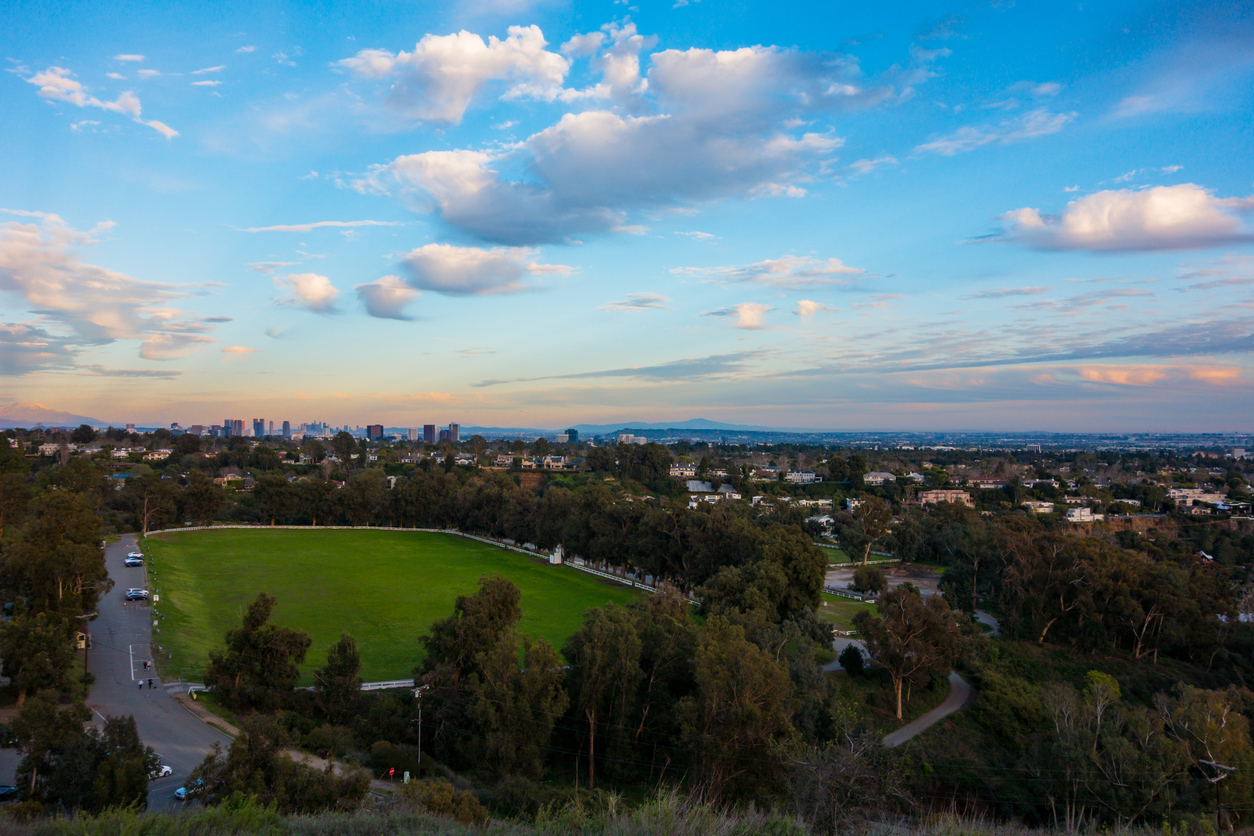
If you drive up Sunset Boulevard as it begins to wind into the Santa Monica Mountains, Los Angeles begins to feel less like a city built around traffic and screens. The road climbs through canyon vegetation and old residential pockets before reaching a landscape that is unusually open for the Westside.
That landscape is Will Rogers State Historic Park, the former Pacific Palisades ranch of Will Rogers.
Most visitors know it for its lawns, riding trails, views, or weekend polo. What makes it exceptional is more specific: California State Parks identifies it as the last remaining public, outdoor grass polo field in Los Angeles County. The field is slightly smaller than modern regulation dimensions, but it is still used for public matches during the season.
That fact alone makes the park unusual. Los Angeles has retained individual barns, stables, bridle paths, and horse-property neighborhoods. It has not retained many public landscapes where the older equestrian life of the city is still visible in its original setting.
A Ranch Above the City
Will Rogers bought the first major tract of land here in 1922. Over time, he assembled a larger ranch that, according to California State Parks, eventually grew to about 359 acres overlooking the Pacific. The present state historic park encompasses 186 acres of that former ranch landscape.
Rogers was already one of the country’s best-known entertainers: a vaudeville performer, columnist, radio figure, actor, and the “cowboy philosopher” whose humor and commentary made him a national celebrity. At the ranch, though, he built a working family property rather than a formal Hollywood estate.
The house began as a modest six-room cabin. It expanded over the years into a 31-room ranch house with guest accommodations, stables, corrals, riding areas, a golf course, and trails. California State Parks’ historical material describes work beginning on the polo field in 1926, with mule teams grading the hillside ground over a period of roughly two years.
The resulting field was not simply a decorative amenity. Rogers played polo there, and the ranch became a gathering place for friends in Hollywood and the equestrian world. California State Parks identifies Walt Disney, Spencer Tracy, Leslie Howard, and Clark Gable among the entertainment figures who played at the ranch when Rogers was in town.
That is the useful distinction between the Will Rogers field and a generic “old Hollywood” anecdote. The field was part of an active ranch and a real sporting life, not merely a backdrop for celebrity photographs.
The Field That Remained
The ranch entered public ownership after Rogers’ widow, Betty Rogers, donated it to the State of California following her death in 1944. It became Will Rogers State Historic Park, preserving a portion of a landscape that might otherwise have been subdivided and absorbed into the expanding Westside.
Today, California State Parks manages the property and maintains the polo field. The Will Rogers Polo Club continues the site’s playing tradition, while the Will Rogers Ranch Foundation supports preservation and historical interpretation.
The field remains a functioning place, not an exhibit. Public polo games are generally held on weekends from May through mid-October, excluding Memorial Day, the Fourth of July, and Labor Day. Matches are free to watch, though visitors pay the standard vehicle-parking fee.
For someone interested in Los Angeles equestrian culture, the appeal is not that the park recreates an untouched past. It does not. The city has grown around it. The old ranch is now surrounded by expensive neighborhoods, canyon roads, and the dense urban economy of the Westside.
The appeal is that a public grass polo field still exists here at all—and that the game is still played on it.
The Hollywood Version of Polo
The polo scene in Pretty Woman helped fix a particular image of the sport in the public imagination: wealthy spectators, hats, champagne, divots, and a social world that feels inaccessible to most people.
That scene has a Los Angeles connection, but not a Pacific Palisades one. The Los Angeles Equestrian Center in Burbank lists Pretty Woman among the productions filmed there. The facility’s film-location material identifies its Cricket Field as one of the major outdoor production spaces on the property.
The distinction is worth making. The Burbank location supplied Hollywood with a polished visual shorthand for wealth and leisure. Will Rogers State Historic Park offers something different: the original setting of a working ranch whose owner happened to be one of the most famous entertainers in America.
Polo has long carried associations with money, social status, and exclusive circles. In Southern California, however, its history also runs through ranch culture, horses, film-industry friendships, public recreation, and the survival of open land in an increasingly built-out city.
That is why the Will Rogers field matters. It gives the public access to a piece of that history without requiring club membership, property ownership, or an invitation into a private equestrian world.
A Park Changed by Fire
The park’s history now has a clear before-and-after line: the Palisades Fire of January 2025.
As California State Parks reported, the fire destroyed Rogers’ historic 31-room ranch house, the horse stables, and other structures at the park. Park staff had evacuated horses and some cultural artifacts before the fire reached the property, but the loss of the house was profound.
When the park reopened after ten months of closure, CBS Los Angeles reported that a stone chimney and small parts of the ranch-house structure remained. The gatehouse and foreman’s cottage survived elsewhere on the grounds, as did the polo field.
That survival changes how the field reads today. It is no longer simply one feature in an intact historic ranch complex. It is one of the most visible surviving parts of the property’s original working and recreational landscape.
The park has reopened with restrictions as restoration continues. According to California State Parks’ February 2026 visitor information, the Backbone Trail, Rivas Canyon Trail, Rustic Canyon Trail, and the southern section of Bone Canyon Trail remained closed. Portions of the Inspiration Loop could also close intermittently during repair work.
For now, Will Rogers State Historic Park is best understood as a public historic landscape in recovery. The ranch house is gone. Trail access remains limited. But the field is still there, the lawn is open, and polo continues during the season.
That is enough to make it more than a scenic stop above Sunset Boulevard. It remains one of the clearest places to see how Los Angeles once accommodated horses, open land, sport, and celebrity—and how little of that landscape is left.
Visitor Information
| Detail | Information |
|---|---|
| Location | 1501 Will Rogers State Park Road, Pacific Palisades, CA 90272 |
| Polo season | Weekend games generally run from May through mid-October, excluding Memorial Day, the Fourth of July, and Labor Day |
| Admission | Polo matches are free to watch; standard vehicle-parking fees apply |
| Before visiting | Confirm live match times, parking, park access, and trail conditions with California State Parks or the Will Rogers Polo Club |
| Trail conditions | Recovery-related closures and intermittent restrictions remain possible; check the park’s current conditions before planning a hike |