Table of Contents
- From Ranchos to Horse Culture
- Polo Arrives in California
- The Rise of Westside Polo
- Hollywood Goes to Polo
- Will Rogers's Polo Ranch
- Riviera and the 1932 Olympics
- Polo, the Military, and Sport
- Fields, Estates, and Disappearing Open Space
- How Los Angeles Polo Changed
- A Living Legacy
Long before Southern California became synonymous with freeways, studio lots, and suburban development, much of the Los Angeles region was shaped by open land, ranching, and life on horseback. Formal polo was not a direct continuation of the Spanish and Mexican rancho system—it arrived later through American and British sporting culture—but it found fertile ground in a region already deeply familiar with horses, cattle work, riding, and equestrian display.
One of the clearest surviving links to the history of polo in Los Angeles is the polo field at Will Rogers State Historic Park in Pacific Palisades. For a closer look at Will Rogers’s ranch, the field’s Hollywood-era role, and its survival as Los Angeles County’s last public outdoor grass polo field, see "The Last Chukker: Will Rogers, Pacific Palisades, and L.A.’s Equestrian Soul."
From the late nineteenth century through the interwar years, polo became a distinctive part of Los Angeles life. It connected early resort communities, wealthy landowners, military traditions, Hollywood celebrities, and a growing culture of private clubs and outdoor recreation. Its grandest era did not permanently remake Los Angeles in the way railroads or freeways did, but it left a durable cultural imprint—most visibly at Riviera Country Club and the historic polo field at Will Rogers State Historic Park.
From Ranchos to Horse Culture
The Los Angeles Basin was not an empty wilderness before the arrival of organized polo. During the Spanish and Mexican periods, vast ranchos structured much of Southern California's landholding and economy. Ranchos such as Rancho San Rafael, Rancho La Brea, Rancho San Pedro, Rancho Santa Anita, and Rancho Los Cerritos relied on horses for cattle work, transportation, supervision of large properties, and social life.
Vaqueros developed highly skilled traditions of riding, roping, stock handling, and saddle craft. Those practices were not polo, and it is important not to confuse the two. Polo came to California under rules and customs associated with British and American club sport. Still, the region's preexisting horse culture helped make equestrian recreation socially legible to wealthy residents and attractive to newcomers who wanted to participate in a romanticized version of California's ranching past.
By the late nineteenth century, Southern California had become a place where several horse traditions overlapped:
- Rancho-era horsemanship and cattle culture.
- Thoroughbred racing and breeding.
- Riding academies and private stables.
- Military riding and cavalry-related sport.
- Recreational riding in emerging resort and residential communities.
- Film-industry demand for trained horses, stunt riders, and Western imagery.
Polo became one highly visible expression of that larger equestrian world.
Polo Arrives in California
The earliest organized polo efforts in California date to the 1870s. Captain Nell Mowry, a noted endurance rider in the San Francisco Bay Area, was among the early figures associated with attempts to introduce the game. Those first efforts had limited traction, but the sport gained a more durable foothold in Southern California during the 1880s.
English enthusiasts including C. A. Summers and Captain Hutcheson helped promote polo in Los Angeles. Their work contributed to the establishment of the Santa Monica Polo Club in 1888, founded by Dr. J. A. Edmonds and U.S. Senator John P. Jones. Riverside followed with its own polo club in 1891.
The Santa Monica club was not a trivial social experiment. Senator Jones served as its president by 1890, showing the degree to which early polo attracted politically connected and affluent participants. These clubs belonged to an era when Southern California was marketing itself to visitors, investors, health seekers, and wealthy easterners as a place of sunshine, land, leisure, and outdoor sport, a picture reflected in the region's historical society records.
The Pacific Coast Polo and Pony Racing Association helped organize several early clubs before its dissolution in 1909. Its existence demonstrates that polo was not merely an occasional pastime. Even in its early California period, the sport had enough local structure to require shared rules, club relationships, and formal administration.
Southern California offered advantages that mattered to polo players:
- Mild winters and a long outdoor playing season.
- Open land still available near growing cities.
- A wealthy class willing to support club recreation.
- Easy access to horses, trainers, stable hands, and riding culture.
- A social environment that embraced outdoor spectacle and private-club life.
Unlike many northeastern polo centers, where winter halted grass play, Southern California could present polo as part of a nearly year-round sporting lifestyle.
The Rise of Westside Polo
As Los Angeles expanded in the early twentieth century, polo moved from a relatively specialized pursuit into a conspicuous marker of social status. The game was physically demanding, expensive, and inherently theatrical: it required trained horses, acreage, stable staff, equipment, club access, and players willing to accept the risk of falls and injuries.
That combination made polo a natural fit for Los Angeles's affluent Westside culture.
Riviera Country Club was founded in 1926 by members of the Los Angeles Athletic Club and soon became one of the Westside's most prominent private sporting settings. Although Riviera is now best known as one of America's most important golf venues, it also had a meaningful place in the polo culture of the early 1930s.
Its polo field was dedicated on December 3, 1931. Archival photographs and catalog records document polo activity associated with Riviera in the early 1930s, including images of actor Charles Farrell and matches involving Riviera teams and visiting sides. Riviera's grounds represented the convergence of sports, real estate prestige, Hollywood visibility, and Westside leisure that characterized the period.
The Riviera connection also reveals an important distinction: Los Angeles polo was not always centered on one formal "Hollywood Polo Club." Rather, it was sustained through overlapping circles of clubs, private fields, celebrity teams, local enthusiasts, trainers, and social networks. The entertainment industry became one of the sport's most recognizable boosters, but the actual infrastructure was broader than the movie business alone.
Hollywood Goes to Polo
By the 1930s, polo had become embedded in Hollywood's social imagination. It provided an appealing mixture of athleticism, masculinity, pageantry, wealth, horses, and informal business networking. It also offered movie stars a way to participate in a sport that looked glamorous on screen and dramatic in photographs.
Walt Disney became interested in polo in 1932. He recruited several Disney employees and his brother Roy to play, built up a stable of seven polo ponies, and participated in local games. Disney's team was sometimes known as the "Mickey Mouse Team," reflecting the unusual but very real overlap between studio culture and equestrian sport.
Disney was not alone. Spencer Tracy was an enthusiastic polo player during the 1930s, reportedly playing whenever he could get away from the studio. Executives worried about the risk of injury to an actor under contract, a concern that highlights how seriously some stars took the sport.
Darryl F. Zanuck, the powerful studio executive and co-founder of Twentieth Century-Fox, was also associated with Hollywood polo circles. California State Parks identifies Zanuck, Disney, Spencer Tracy, and Howard Hughes among the notable guests entertained at Will Rogers's ranch.
Other figures linked to Los Angeles polo and its surrounding social world included:
- Will Rogers, actor, columnist, humorist, roper, and dedicated polo player.
- Clark Gable, who participated in the Hollywood polo milieu.
- David Niven, who was associated with the sport in 1930s Hollywood.
- Charles Farrell, documented playing at Riviera.
- Hal Roach, producer and equestrian participant in the broader Westside scene.
- Cecil Smith, a noted polo player photographed with Will Rogers at Rogers's field.
The celebrity angle should not obscure the sport's seriousness. Polo required skilled riding, disciplined horse management, tactical awareness, and substantial financial support. Hollywood made it more visible, but it did not turn the game into a mere publicity stunt.
Will Rogers's Polo Ranch
No place better captures the relationship between polo, celebrity, and Southern California horse culture than Will Rogers's Pacific Palisades ranch.
Rogers bought his first parcel of Pacific Palisades land in the early 1920s and continued acquiring adjacent property over time. By his death in 1935, the ranch had grown to roughly 359 acres; today's Will Rogers State Historic Park preserves 186 of those acres. Horses, roping, and polo were central to the property from the beginning. He built temporary stables and corrals and used mule teams to grade the site for a polo field.
The polo field itself was built in 1926—earlier than the ranch house's full development—and Rogers's family moved to the property in 1928. That chronology matters. The ranch was not simply a celebrity home with a decorative horse facility. It was designed around horses and equestrian recreation.
The property eventually included:
- A polo field.
- Stables and corrals.
- A riding arena.
- A roping area.
- Horse pastures.
- A practice polo cage.
- Mule, hay, and support barns.
- Riding trails and open ranch landscape.
Will Rogers's son later described the stable as the true center of ranch life, explaining that horses, polo, roping, and relaxation were core reasons his father bought the property.
Rogers entertained a remarkable circle of Hollywood and public figures at the ranch. California State Parks specifically identifies Walt Disney, Howard Hughes, Darryl Zanuck, and Spencer Tracy among the guests Rogers received there. Archival images also document Will Rogers with polo player Cecil Smith at the field between 1930 and 1935.
Rogers died with aviator Wiley Post in a plane crash near Point Barrow, Alaska, on August 15, 1935. His death ended one of the most visible personal chapters in Los Angeles polo, but the ranch's equestrian identity survived him.
The property became a California State Park in 1944. In 1953, C. D. LeBlanc founded the Will Rogers Polo Club, allowing the field to remain an active polo venue rather than simply a preserved landscape.
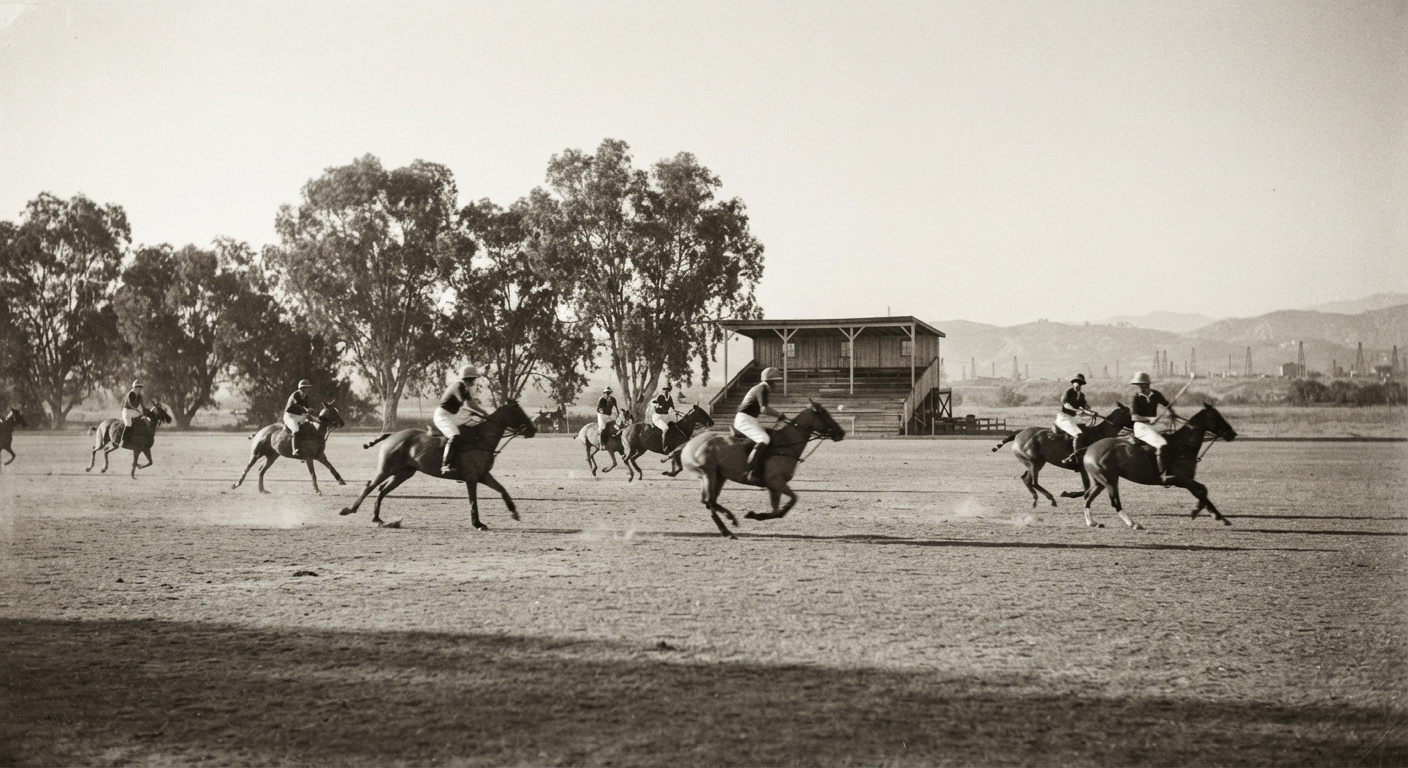
Today, the historic field remains exceptional. California State Parks describes the grass field as slightly smaller than regulation dimensions—about 20 yards shorter and somewhat narrower—but it is the last remaining public, outdoor grass polo field in Los Angeles County, and it continues to host matches during the season. The field therefore functions as both a working sports venue and a surviving physical link to the region's interwar polo culture.
Riviera and the 1932 Olympics
Riviera Country Club played a role in the 1932 Los Angeles Olympics, but not as a venue for field polo.
Riviera hosted Olympic equestrian events and modern pentathlon during the 1932 Los Angeles Games. It did not host Olympic field polo, because polo was not contested at the 1932 Olympics at all. The United States Polo Association notes that there was no Olympic polo in Los Angeles that year.
The frequent source of confusion is water polo. The U.S. men's water-polo team won bronze at the 1932 Games, but that tournament took place at Olympic Park Swimming Stadium, not at Riviera Country Club.
The corrected historical point is still compelling: Riviera was part of the international sporting infrastructure of the 1932 Olympics, while its polo field belonged to the same broader equestrian and recreational culture flourishing on the Westside.
Polo, the Military, and Sport
Polo's military heritage also helped shape its status in the United States. Historically, the game was associated with cavalry training because it demanded rapid riding, coordination, balance, spatial awareness, teamwork, and tactical judgment under pressure.
The U.S. Army played a substantial role in promoting polo beginning in the late nineteenth century. The sport was valued as a way to improve cavalrymen's riding and maneuvering skills, particularly before mechanization ended the horse cavalry's central role in military operations.
That national military tradition gave polo an aura of discipline and athletic legitimacy. In Los Angeles, the sport's appeal was especially broad because it could simultaneously be understood as:
- A demanding riding sport.
- A wealthy club pastime.
- A military-influenced test of horsemanship.
- A social event.
- A photogenic Hollywood spectacle.
- A connection to the region's larger romance with horses and the West.
There is likely more Los Angeles-specific military-polo history to uncover in newspapers, military-post records, polo programs, and local archives. But it is safer to avoid claiming that Hollywood actors regularly played formal teams against active-duty local cavalry units unless those individual matches can be documented.
Fields, Estates, and Disappearing Open Space
Polo did not single-handedly create modern Los Angeles equestrian zoning or determine the geography of today's horse-property neighborhoods. That claim would be too strong. The surviving horse landscapes of Los Angeles County developed through many different forces: rancho history, private estates, public parks, flood-control projects, recreational planning, movie-ranch activity, local advocacy, trail preservation, and later zoning decisions.
Still, polo was part of the historical landscape of open space.
In the 1930s, Los Angeles reportedly had 25 polo fields. That figure is striking because it shows how common the sport's physical infrastructure once was in a metropolitan area now associated with dense development and traffic. Many such fields, riding grounds, pastures, and privately held horse properties disappeared as postwar development accelerated.
The most accurate way to describe polo's relationship to modern equestrian Los Angeles is not as a direct legal or zoning cause, but as one thread in a broader continuity of horse use and horse identity.
That continuity can still be seen in several parts of the region:
- Pacific Palisades, through the surviving Will Rogers polo field, riding facilities, and trail access.
- Griffith Park, through public riding, stables, trails, and the longstanding visibility of horses in central Los Angeles.
- The Hansen Dam and Lake View Terrace area, where public equestrian facilities, trails, and horsekeeping remain important.
- The Verdugo foothills and Shadow Hills, where private horse properties and trail-oriented residential identity persist.
- Rolling Hills and the Palos Verdes Peninsula, where large-lot residential patterns and bridle infrastructure continue to support equestrian life.
- Malibu and the Santa Monica Mountains, where ranch landscapes, trails, private estates, and film-era horse culture overlap.
Each place has its own land-use history. A careful local-history article should not imply that every surviving equestrian district began as a polo field. But polo's popularity helps explain why horse sport, stables, and riding carried social prestige in twentieth-century Southern California.
How Los Angeles Polo Changed
Los Angeles did not stop caring about horses after the 1930s, but the city's relationship to polo changed. Several forces made the sport less central to metropolitan life:
- Postwar suburbanization consumed open land.
- Rising land values made large grass fields difficult to maintain.
- The automobile and freeway system reshaped leisure patterns.
- Studio-era social networks changed.
- Horse racing, golf, tennis, and other sports became more commercially visible.
- The most prominent California polo centers increasingly shifted toward places with more available land and stronger dedicated club infrastructure, particularly Santa Barbara and, later, the Coachella Valley.
Yet polo did not disappear. California Polo Club continues the sport in Los Angeles through arena polo, instruction, horse training, boarding, and major events such as the U.S. Arena Polo Open. At the same time, Will Rogers Polo Club preserves grass-field polo at one of the most historically resonant sites in the county.
This creates a useful distinction for modern readers: Los Angeles is no longer California's best-known center for high-goal polo, but it remains historically important to the sport and retains active, visible links to its past.
A Living Legacy
The history of polo in Los Angeles is ultimately a story about more than mallets, ponies, and celebrity spectators. It reveals how the city once used horses to imagine itself: Western but cosmopolitan, rural but modern, athletic but theatrical, locally rooted but internationally aspirational.
Polo arrived as an imported club sport, not as a direct inheritance from the ranchos. But it flourished because Southern California already possessed an unusually deep relationship with horses. The region's rancho traditions, open landscapes, film culture, wealth, military associations, and appetite for outdoor recreation all made the game feel at home.
The surviving polo field at Will Rogers State Historic Park is the clearest reminder of that era. It is not merely a picturesque relic. It is a functioning polo field on a ranch purpose-built around horses, riding, roping, and polo—a rare surviving fragment of a Los Angeles when the sound of hoofbeats could still carry across the hills above the Pacific.