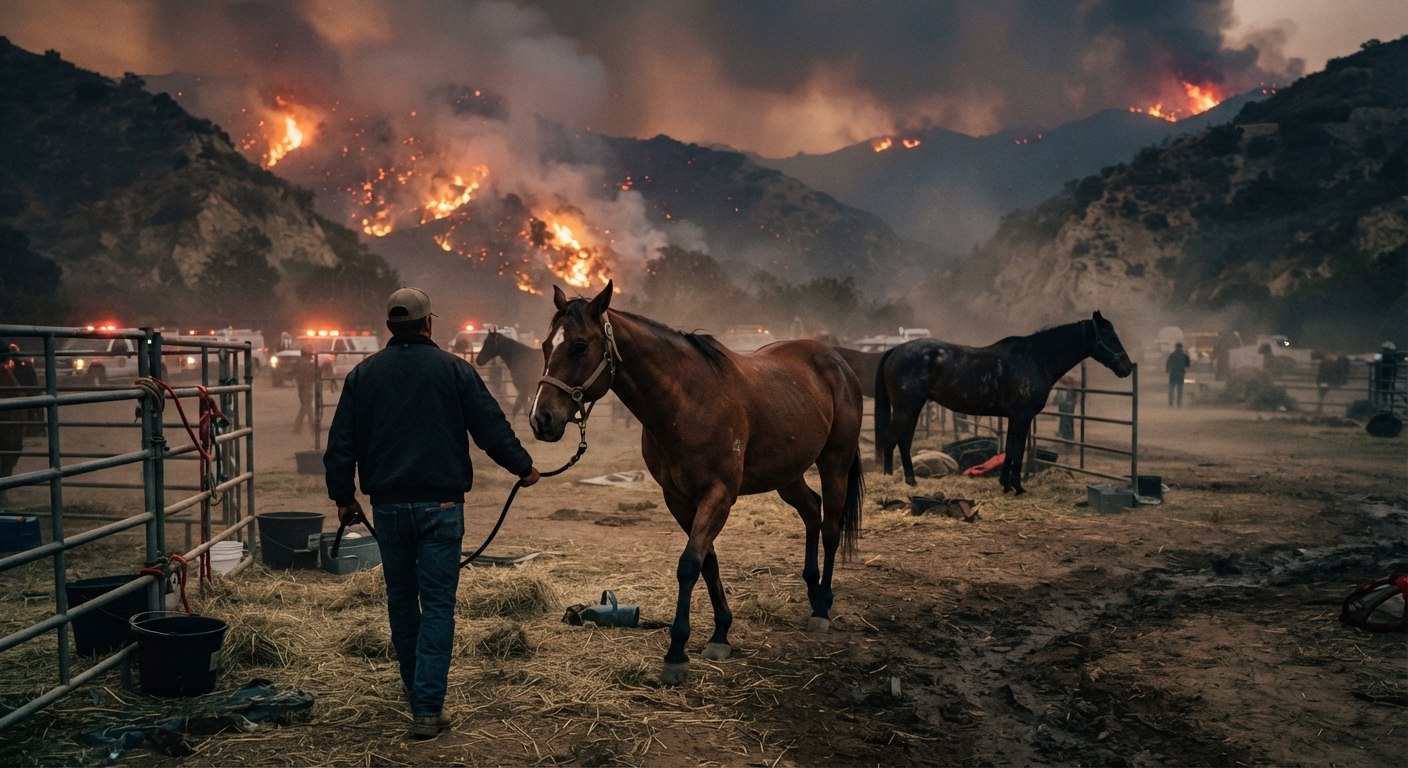
The Palisades Fire was one of several destructive wind-driven fires that began across Los Angeles County on January 7, 2025. Although the Palisades Fire became one of the most damaging fires in Los Angeles history, it was part of a wider emergency that included the Eaton Fire and other simultaneous incidents.
That distinction matters when discussing horses. Public records document a major regional animal-evacuation response, but they do not provide a definitive public count of horses displaced by the Palisades Fire alone. The clearest documented story is broader: the January 2025 fire emergency displaced horses and other large animals across Los Angeles County, requiring shelter, transportation, animal care, and coordination on a regional scale.
Horses in a Regional Emergency
For horse owners, wildfire evacuation is more complicated than loading a pet into a vehicle. Horses require trailers, safe loading access, passable roads, suitable receiving facilities, secure pens or stalls, water, feed, supervision, and experienced handlers.
As evacuations expanded, Los Angeles County's emergency animal sheltering notice identified the Los Angeles Equestrian Center in Burbank and Industry Hills Equestrian Center as locations able to receive horses. The same notice announced that Pierce College and Hansen Dam Equestrian Center had reached capacity, and directed large-animal owners to the County's Agoura Hills, Castaic, and Lancaster animal care centers.
The early capacity constraints showed how quickly a wildfire can strain the horsekeeping system. Having a trailer did not necessarily mean an owner had a safe destination available. Facilities receiving evacuated horses needed space, water, feed, staff, fencing, and the ability to manage animals arriving from different properties under stressful conditions.
Emergency Sheltering
In its report on the January firestorms, the Los Angeles County Department of Animal Care and Control (DACC) said it received 460 animals into emergency sheltering over an 11-day period, including 205 horses. The department opened large-animal evacuation sites at Pierce College, the Antelope Valley Fairgrounds, and its Castaic Animal Care Center.
DACC also reported that hundreds more horses and livestock were evacuated to the Los Angeles Equestrian Center, Hansen Dam Equestrian Center, Industry Hills Equestrian Center, the Fairplex in Pomona, and other locations. These figures describe the wider January 2025 fire emergency; they should not be treated as a count of animals displaced by the Palisades Fire alone.
At the Pierce College sheltering site, DACC's volunteer Equine Response Team cared for more than 200 animals. Because Pierce College was one of DACC's own sheltering sites, the more than 200 animals reported there should not be added to the department's 460-animal total.
What Evacuation Required
Moving a horse to safety was only the first part of the response. Once horses arrived at a temporary site, they had to be identified, placed safely, fed, watered, monitored, and managed around unfamiliar animals and people.
Receiving facilities needed usable stalls or pens, secure fencing, staff or volunteers, manure-management capacity, access to veterinary assistance, and room to continue accepting animals as conditions changed. The response also relied on trailer owners, private barns, equestrian centers, animal-care personnel, veterinarians, and volunteers who helped provide transport, temporary space, supplies, and hands-on care.
The emergency was not limited to animals that could be moved immediately. DACC acknowledged that many animals were not evacuated in time. During the wider fire response, its field teams brought hay and water to stranded livestock and rescued a horse from a devastated property in Altadena.
The Palisades Fire's Wider Impact
The Palisades Fire affected the regional horse community beyond its immediate evacuation zone. As fires spread, warnings changed, and roads closed, temporary boarding capacity became a countywide concern. Facilities that received evacuated animals had to adapt their normal operations, while owners elsewhere tracked official updates and searched for safe destinations.
For displaced horse owners, reaching an evacuation site did not eliminate uncertainty. Many still had to determine when they could return, whether their usual barn remained accessible, how long temporary boarding could continue, and whether normal feed, medication, turnout, and care routines could be maintained.
The January 2025 fires therefore tested more than individual evacuation plans. They tested the availability and capacity of Los Angeles' large-animal infrastructure and the ability of equestrian facilities and horse owners to respond collectively.
What the Response Revealed
The January 2025 emergency demonstrated the practical value of Los Angeles County's equestrian infrastructure. Public equestrian centers, college facilities, County animal-care sites, private boarding barns, horse transporters, veterinarians, animal-control staff, and volunteers all formed parts of the emergency response.
The response depended on facilities that already had the physical ability to receive horses and other large animals. It also depended on people who could move animals, communicate available capacity, provide care, and support owners whose usual arrangements had suddenly failed.
The most defensible conclusion is not that a known number of horses were affected by the Palisades Fire alone. It is that the Palisades Fire was a central part of a wider January 2025 Los Angeles fire emergency that required extensive large-animal evacuation and sheltering across the county.